


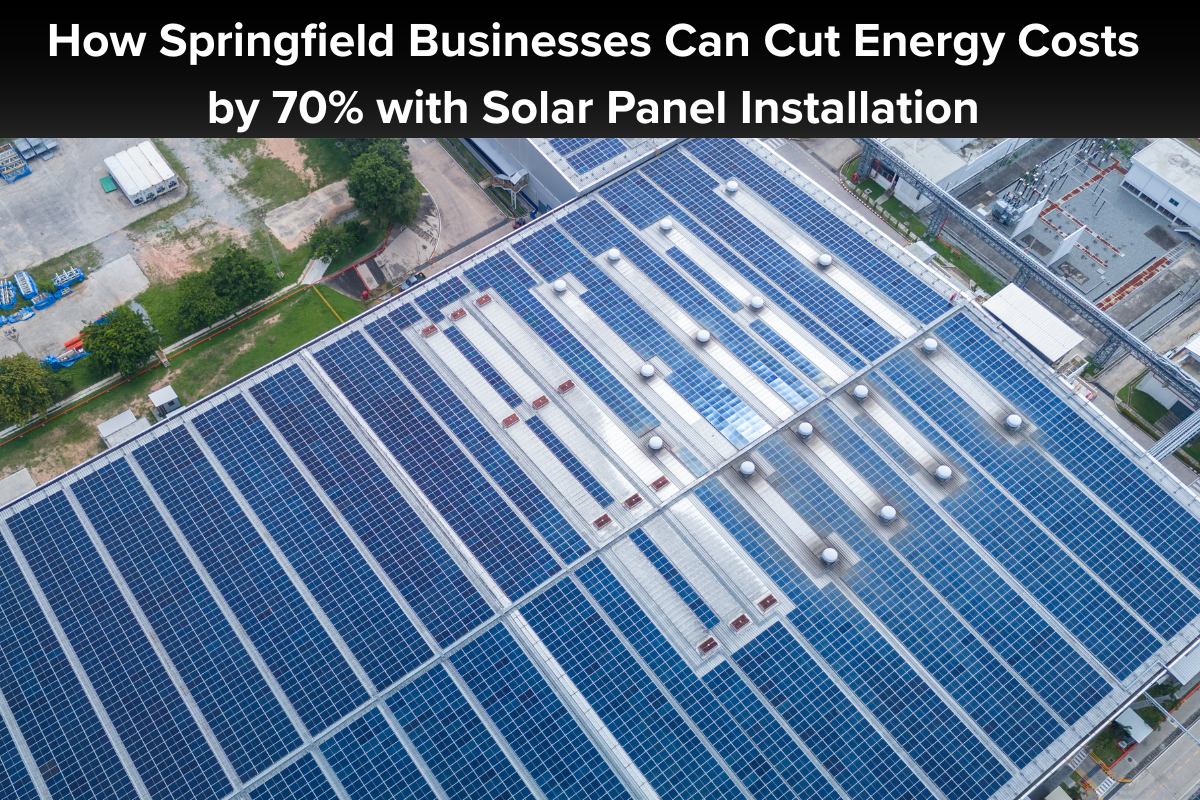
How Springfield Businesses Can Cut Energy Costs by 70% with Solar Panel Installation
Every month, Springfield business owners write checks to their utility company, checks that grow a little larger each year as electricity rates continue their steady climb. If you’ve been watching your operating costs and wondering where the fat can be trimmed, the answer may be sitting right above your head, on your roof, soaking up the sun.
Solar panel installation for businesses has moved well past the “early adopter” phase. Today, commercial solar is a proven, numbers-backed strategy that businesses across the Midwest are using to dramatically reduce overhead, in many cases slashing energy costs by 50% to 70%. Here’s everything you need to know about how it works, why it makes financial sense, and what the process looks like for a Springfield business.
Why Energy Costs Are Hurting Springfield Businesses
Commercial electricity rates in Missouri have trended upward for over a decade, and there’s no credible forecast suggesting that changes. For businesses with significant energy loads, manufacturers, auto dealerships, healthcare facilities, retail centers, and hotels, electricity can represent one of the top three operating expenses on the P&L.
The frustrating reality? Most businesses are completely at the mercy of their utility provider. There’s no negotiating a better rate, no way to lock in pricing, and no protection when the grid gets stressed and rates spike. Solar changes that equation entirely. When you generate your own electricity, you own your power, and the utility company’s rate increases become largely irrelevant.
Businesses already struggling with rising utility expenses may also want to read our guide on why electricity bills are so high in Springfield and how solar helps reduce long-term costs.
How Solar Panel Installation Actually Reduces Costs
The mechanics are straightforward. Solar panels installed on your commercial facility convert sunlight into electricity that directly powers your building. Any electricity you generate is electricity you’re not buying from the grid. At commercial consumption levels, even a moderately sized solar system can offset a substantial portion of monthly utility bills from day one.
But the savings story doesn’t stop at reduced consumption. Two additional mechanisms amplify the financial return:
Net Metering
It allows your business to send excess electricity back to the grid and receive credits on your utility bill. This Show Me State offers net metering for commercial solar installations up to 100 kilowatts, while Arkansas extends that to 300 kilowatts. This means your panels work as a silent revenue generator during peak sunlight hours, and those credits offset what you draw at night or on overcast days.
The ROI Timeline: What Springfield Businesses Can Expect
Business owners are rightly focused on the payback period. The good news is that commercial solar in Missouri and Arkansas has become one of the more compelling capital investments available to small and mid-sized businesses.
When you account for reduced monthly utility bills, net metering credits, MACRS depreciation, and any applicable USDA REAP grants (which cover up to 40% of costs for qualifying rural businesses and agricultural producers, and don’t need to be repaid), the effective payback period for many commercial solar systems falls in the range of four to seven years. The panels themselves are typically warranted for 25 years, meaning businesses can enjoy 18 to 20 years of essentially free electricity after the system pays for itself.
The math gets even more compelling when you factor in rising utility rates. Every year electricity costs increase, your solar savings increase in parallel, because you’re generating more of what you’d otherwise be buying at a higher price.
If you’re evaluating whether commercial solar makes financial sense for your Springfield business, now is the time to explore your options. Call Solera Energy today to schedule a consultation and learn how a customized solar panel installation for businesses can help reduce long-term operating costs.
Who Benefits Most from Commercial Solar in Springfield?
Nearly any business with a suitable roof or property can benefit, but some industries see particularly strong returns:
• Manufacturing and distribution centers tend to have large roof footprints and high daytime energy loads, an ideal combination for maximizing solar output and consumption alignment.
• Retail and Office Buildings benefit from the fact that peak solar generation hours align almost perfectly with peak business hours.
• Healthcare Facilities value both the cost reduction and the energy independence that battery backup options provide.
• Auto Dealerships, Hotels, and Schools all carry significant utility overhead that solar reliably reduces.
The common thread is predictable daytime energy consumption. If your business is operating during daylight hours, your solar system is generating electricity precisely when you need it most.
Take Control of Rising Energy Costs
The conversation about solar has shifted. It’s no longer a question of whether the technology works; it demonstrably does, or whether it makes financial sense for businesses. The question is simply: how long are you willing to keep paying utility rates that are outside your control, when a proven alternative exists?
If your Springfield business consumes meaningful amounts of electricity during daytime hours, a commercial solar installation from Solera Energy can be beneficial. With over a decade of experience serving Missouri’s solar needs, our expertise extends across Kansas City, St. Louis, Joplin, Columbia, and neighboring regions in Arkansas and Illinois, providing customized commercial solar solutions informed by local utility rules, permit processes, and performance data.
Ready to see what solar could do for your Springfield business? Contact us to schedule your free consultation.
Frequently Asked Questions
How much can a Springfield business realistically save with solar?
Savings depend on system size, energy consumption, and applicable incentives, but commercial customers frequently reduce energy costs by 50% to 70%.
How long does a commercial solar installation take in Missouri?
The timeline varies based on permit approvals and system complexity, but most commercial installations move from design to final commissioning in a matter of weeks. A reputable installer handles permitting, net metering approval with the utility, and all inspections on your behalf.
Do solar panels work on cloudy days or during Missouri winters?
Yes. Solar panels generate electricity in diffuse light conditions — they don't require direct sunlight. Output is reduced on heavy overcast days and in winter months, but the annual generation profile for Missouri is strong enough to deliver compelling economics. Net metering credits built up during high-production months help offset lower-production periods.
What happens if my business generates more electricity than it uses?
Excess electricity flows back to the grid, and your business earns net metering credits on your utility bill. Missouri allows commercial net metering up to 100 kW; Arkansas extends that to 300 kW.
Does Solera Energy offer financing for commercial solar installations?
Yes. Solera Energy works with a range of financing partners to offer loan and lease options that make solar accessible for businesses of varying sizes. Their team can walk you through the options and help you identify which incentive programs your business qualifies for before you commit to anything.
Here’s Why Our Customers Love Us